Product update
MIA Agentic AI Marketing Platform for Tourism Insights and GEO
Explore MIA's Agentic AI Marketing Platform, with planned updates for tourism research, clearer GEO reporting and easier ways to share your feedback.
- Sources cited
- 0
- Sections
- 4
- Languages
- EN · 繁體 · 简体
Marketing questions rarely stop at one answer. A report might reveal a change in traveler behavior that you want to explore. An AI answer might mention your brand but recommend a competitor. Before deciding what to do next, you need to understand why.
That's the thinking behind our latest work on MIA, our Agentic AI Marketing Platform. We're bringing together tourism research, clearer generative engine optimization (GEO) reporting and an easier way to share feedback. The aim is to help you move from a question to useful research, understand the findings and continue the conversation when you need more detail.
Here's a look at the updates we're preparing and how they can help with your day-to-day marketing work.
Tourism research that starts with your questions
If you work in tourism, you know how much goes into understanding a market. Traveler conversations, booking concerns and competitor activity can all matter, but bringing them together takes time.
Our first industry-specific reporting experience, Tourism Market Insights, is designed for airlines, hotels, attractions, theme parks and destinations. It brings research into a report shaped around your brand, audience and business questions.
You might want to explore what mainland Chinese outbound travelers consider when choosing an airline. Or you might need a clearer picture of the concerns people raise when planning a visit to your destination. Those questions give the research a direction, so you can focus on information that helps with the decision ahead.
Agree on the research before it begins
MIA will use the brand information you've already provided and ask you to confirm anything that's missing. Before collecting data, MIA will outline the research scope for your approval.
This is your chance to check that the audience, market and questions match what you need. If the brief is too broad or misses something important, you can adjust it before the work starts.
Once it's available, open Quick Actions and choose the option to generate a tourism industry insights report. Add and select Tourism Market Insights, then review the proposed research plan.
Get the key findings and explore further
Each report will open with an Insight Trailer: a summary of the key findings and the evidence behind them. From there, you can explore market context, traveler needs, concerns affecting travel decisions, competitor performance and suggested marketing actions.
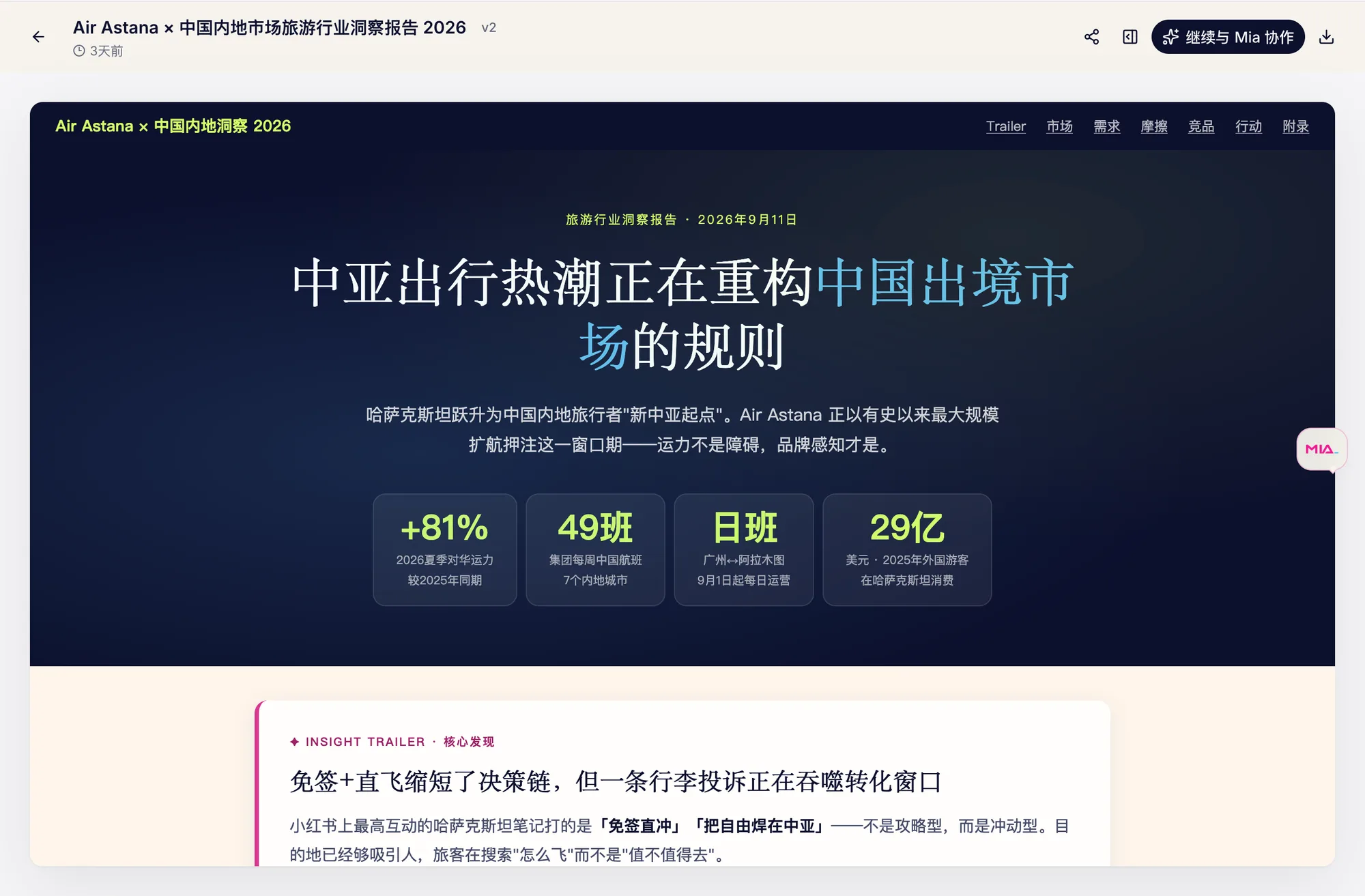
Source links and clear explanations of research gaps will help you judge how much weight to give each finding. If the available information only answers part of your question, the report should make that clear.
You'll also be able to keep working with the report through conversation. Ask MIA to clarify a finding or revise a section, then return to earlier versions when you need to review what changed. In Reports, you'll be able to view text, visuals and interactive layouts, download HTML or share the report with colleagues.
Tourism is our starting point. This first release won't include dedicated reports for other industries, and access will depend on the relevant capability and data connections.
A clearer picture of your brand in AI answers
When someone asks AI for a recommendation, does your brand appear? Is it simply mentioned, or is it suggested as a choice? And how does that compare with the competitors you're tracking?
These are different questions. We're updating MIA GEO to make the differences easier to see and the results easier to explain.
Understand what the questions are testing
An answer to "Tell me about this hotel brand" tells you something different from an answer to "Which hotels are good for a family trip?" The first prompt already names the brand. The second gives AI room to suggest its own choices.
MIA GEO's updated checks will better distinguish brand-led prompts from broader category questions. They'll also improve filtering for duplicate questions, outdated years and wording that doesn't sound natural.
We're improving brand recognition too, including how MIA handles aliases and competitor names. Potential new competitors will need supporting evidence and your confirmation before they're added to tracking. This will help keep comparisons focused on the brands you intend to follow.
See which answers are included
A missing result can be frustrating, especially when you can't tell whether it means poor performance or missing information.
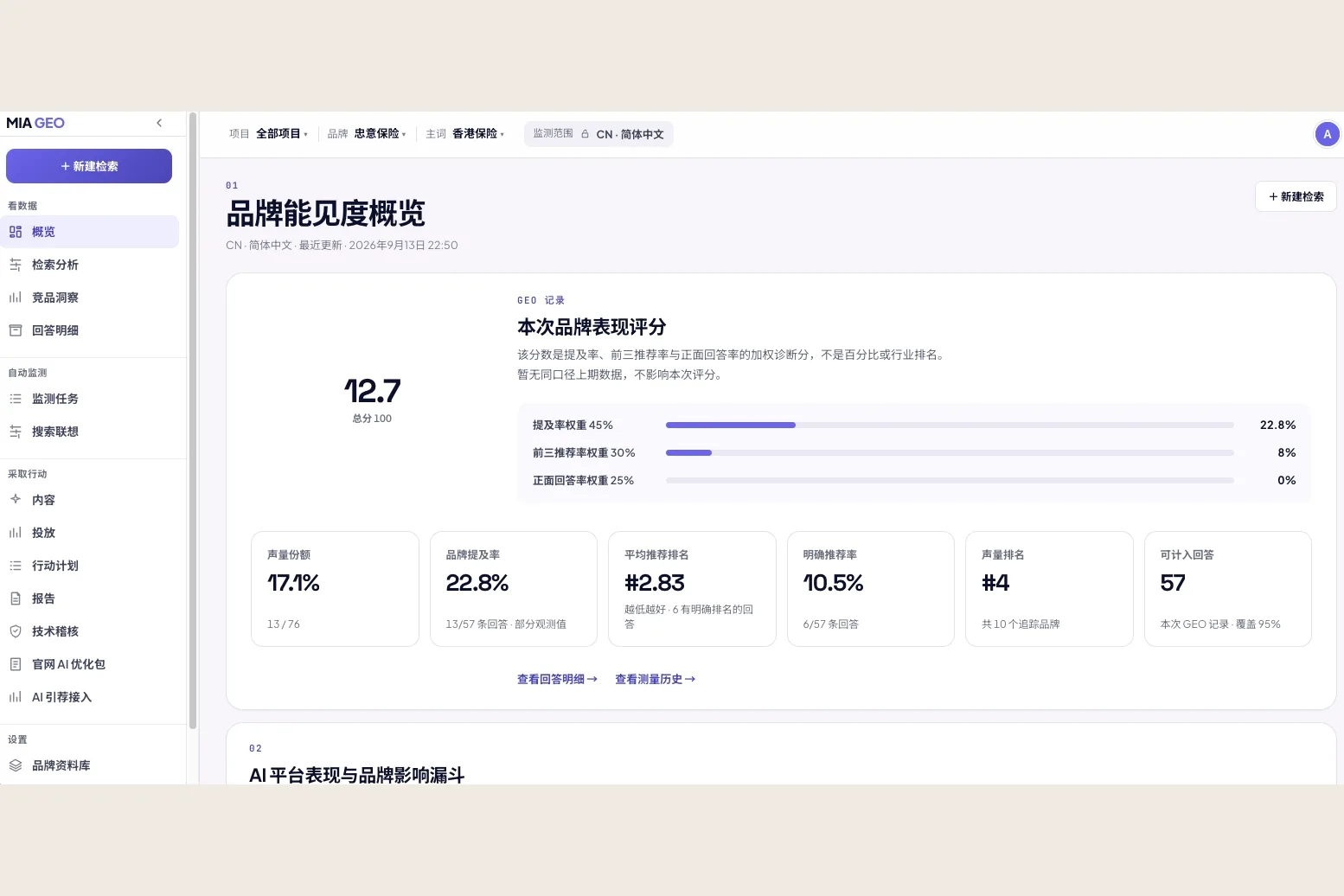
The updated reporting will distinguish the answers expected, the answers received and the answers included in your metrics. Any supplementary answers will be shown separately. When a ranking or sentiment can't be determined, you'll see an explanation rather than having to guess what the gap means.
That gives you a useful starting point when a result looks unexpected: check which answers came back, see which were counted and open the evidence before drawing a conclusion.
Make comparisons with the right context
We're also making the metrics more explicit. Share-of-voice rank and average recommendation position will appear separately, helping you distinguish visibility from where a brand appears in recommendations.
Share of voice will be based on your brand and the competitors you've selected. It describes that tracked group; it doesn't represent your share of the whole industry.
Source analysis will separate citation counts, distinct links and distinct websites. One page cited repeatedly tells a different story from several websites being cited, and you'll be able to see that distinction more clearly.
When you need to explain a result to a colleague or client, you'll be able to open the model and answer details and review the supporting evidence. The new question filtering and collection improvements will apply to new measurements. Historical results will continue to show the evidence already available.
Tell us what's working and what needs attention
Your feedback helps us understand where MIA is useful and where the experience needs work. We're making it easier to share that feedback while you're using the platform.
The updated MIA Feedback control will stay accessible when the desktop sidebar is collapsed and on mobile. You can choose one of three experience ratings and submit it on its own, or add a comment about a problem, an idea or something that worked well.
If you'd rather speak, voice input will create a text draft for you to review and edit before sending. Closing the panel or encountering a recoverable submission error will preserve your draft, so you won't have to start again. You'll also be able to choose whether to include basic browser diagnostics when reporting an issue.
Bring your next marketing question to MIA
These updates are built around the questions that come up in everyday marketing work: what your audience needs, how your brand appears in AI answers and what the evidence tells you to explore next.
Start with a tourism research brief or a question about your brand's AI visibility. Review the available capabilities in MIA, look into the findings and keep asking questions as your thinking develops.
Want to see how MIA could fit into your team's work? Contact us to request a trial.
More articles
Keep reading
See how MIA carries the brief through Insight, Cowork and IQ.
The constraint set described here is what MIA IQ holds between tasks.