
MIA Daily
MIA Daily: five AI checks for brand teams — 15 October 2026
A practical reading list on AI voice, video, agent memory, observability and document parsing, with official sources and a concrete check for each.
- Sources cited
- 9
- Sections
- 8
- Languages
- EN · 繁體 · 简体 · 日本語
Counted from the article file at build time, not asserted. Every claim below opens to one of these sources.
Five checks before expanding an AI workflow
A voice that sounds right, a video that keeps the product intact, an agent that remembers the brief: these are useful things to test before expanding an AI workflow. This edition brings together a new Claude announcement, an earlier document-parsing release and current product guides.
1. HeyGen: listen to the brand name before approving the voice
HeyGen’s Voice Library guide describes voice previews and filters for accent, emotion and use case. Its voice-cloning page describes a consent-first process with ownership verification.
Brand check: use one approved script containing the brand name, a product term and a price. Have a speaker familiar with the target market listen for pronunciation, pacing and meaning. Keep voice permission separate from script approval; a polished sample does not establish either.
2. Runway on Baseten: distinguish generation from editing
Baseten lists Runway’s Gen-4.5 for video generation and Aleph 2.0 for editing existing footage. Both listings identify a proprietary Runway licence. Baseten separately describes single-tenant dedicated deployments.
Brand check: compare a new-shot brief with an edit to footage your team is authorised to use. Define what must stay unchanged, including packaging, logos and required wording. Confirm the particular model’s licence and deployment terms with the provider before treating a hosting option as suitable for unreleased campaign assets.
3. Deep Agents: test recall after the conversation grows
LangChain’s Deep Agents overview documents filesystem tools for moving context out of the conversation and automatic summarisation for long histories. These are context-management mechanisms, rather than a guarantee of perfect recall.
Brand check: give a workflow an initial brief with a target market, a prohibited claim and a source requirement. After several revisions, ask it to retrieve the original constraints and identify their source. Compare the answer against the brief before allowing the next draft to proceed.
4. Claude traces: inspect the steps behind an answer
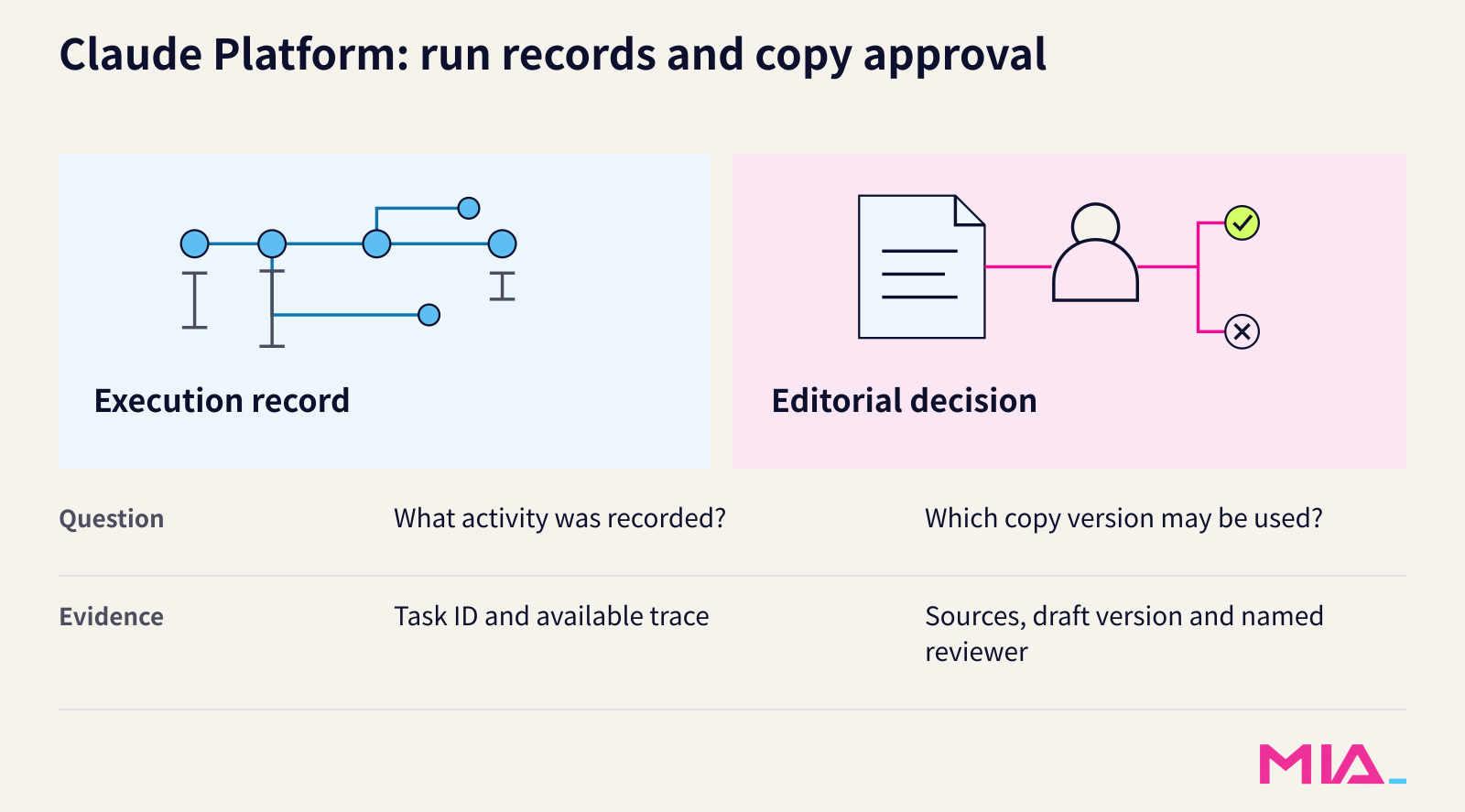
On 14 October, Anthropic announced OpenTelemetry tracing on the Claude Platform in public beta, covering Managed Agents, the Messages API and Claude SDKs. The announcement names LangSmith among the compatible tools.
Brand check: ask your technical team to inspect one research task’s model and tool calls, failures and latency. A trace can help explain how an answer was produced; the cited material still needs checking for accuracy. Review what data the trace destination receives before using a confidential campaign brief.
5. OpenDocRouter: compare parsers on documents you actually use
LlamaIndex introduced OpenDocRouter on 7 October, bringing document-parsing models behind one API. Its ParseBench explanation separates dimensions such as table handling, content faithfulness and formatting.
Brand check: start with a small, authorised set of reports containing tables, footnotes and multi-column pages. Compare extracted names and numbers with the original pages, then record the errors that would change a marketing decision. A benchmark score helps shortlist a parser; your documents determine whether it is usable.
Where should a small team start?
Choose the check that matches an existing problem: pronunciation for localised video, preservation for a product edit, or source accuracy for a research brief. Run it on one approved sample before buying or connecting more tools.
What should the team keep from the test?
Keep the original input, the output, the review criteria and the decision to accept or revise. That gives the next reviewer something concrete to compare, without turning a vendor demonstration into a claim about your own results.
More articles
Keep reading
 AI brief: OpenAI’s voice model successors and Vercel’s MCP Events betaOpenAI documents GPT-Live-1.1 and Quip, while Vercel adds event subscriptions for compatible MCP servers in public beta.MIA Agentic AI Marketing Platform for Tourism Insights and GEOExplore MIA's Agentic AI Marketing Platform, with planned updates for tourism research, clearer GEO reporting and easier ways to share your feedback.
See how MIA carries the brief through Insight, Cowork and IQ.
The constraint set described here is what MIA IQ holds between tasks.