Yes, MIA is fast. No, she won’t go overspeed.
She moves fast through the research, the strategy, the draft. What she won’t do is move past your team. Every output stops at your review queue and waits — no auto-send, no background publishing, no decisions made while you weren’t looking.
The speed is hers. The final call is always yours.
The task line
Everything is automated. Except the decision.
MIA runs the research, builds the strategy, produces the draft — without you lifting a finger. Then she hands it to you. Every output waits at your team’s gate. Nothing moves until a named person on your team approves it. Not because of a setting you turned on. Because that’s how she’s built.
MIA / COWORK · TASK LINE5 stages · 3 lanes · 1 approval hold
1. Brief — everything MIA needs to do the job
The task is defined: the signal, the brand context, the market, the objective. MIA works from what your team has approved — nothing is assumed or invented.
2. Draft — research, strategy, and content, connected
MIA builds the output step by step. Every stage is visible — not just the final result. Your team can see what MIA found, what she concluded, and what she produced.
3. Your review — MIA waits here
Every output lands in your team’s queue. MIA does not proceed until a person reads it. There is no auto-approve, no timer, no workaround.
4. Approved — then and only then it moves
One named person on your team makes the call. That decision is logged. Nothing leaves without it.
5. Remembered — for every cycle that follows
The approval, the edits your team made, any corrections — kept. MIA carries them forward so the next cycle starts smarter than this one.
The hold is not a setting. It is a step in the workflow, and no lane has a way around it.
Product evidence
The gate, in our own workbench.
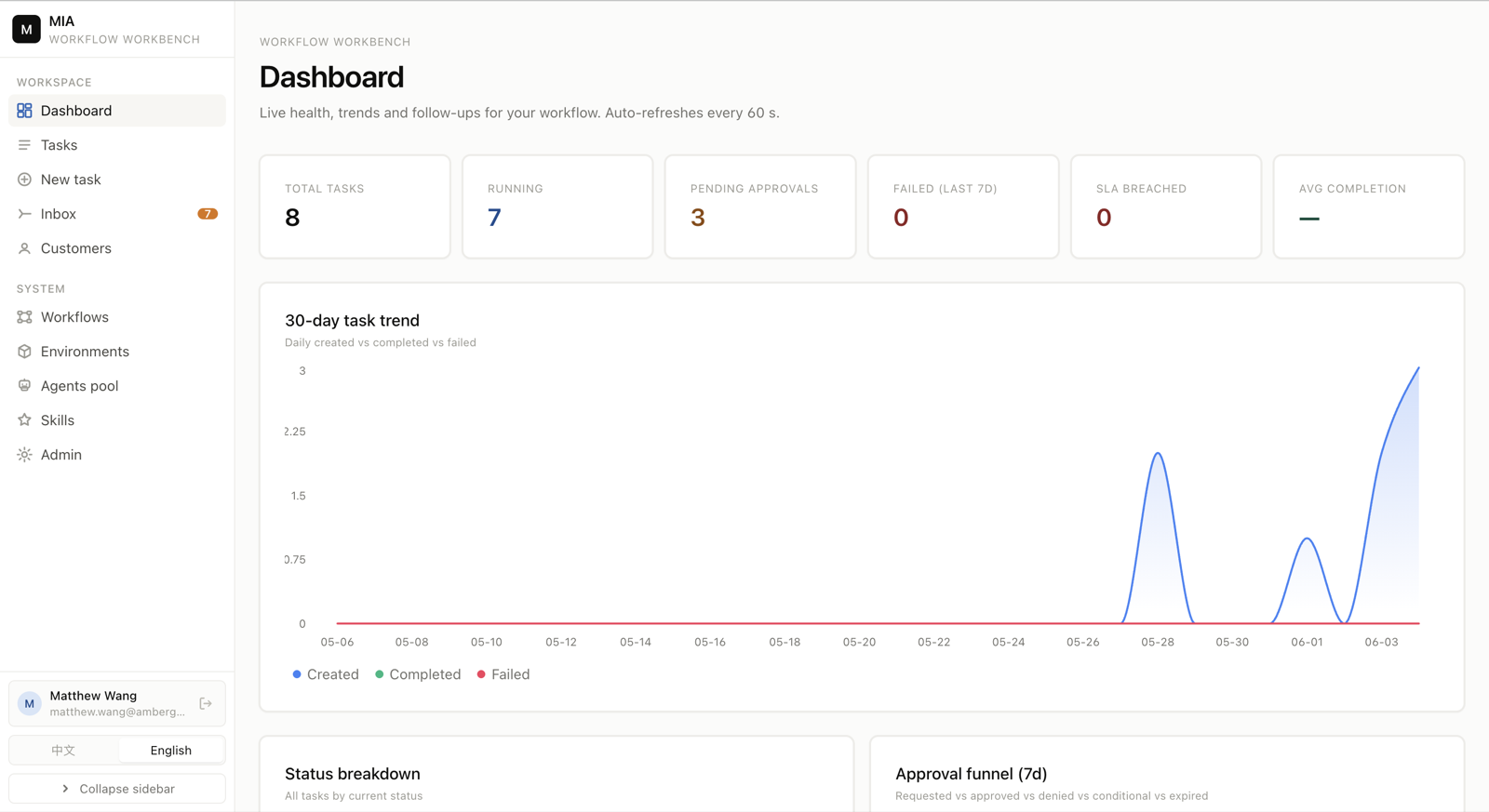
MIA’s internal Workflow Workbench is where these runs are watched. Pending approvals sit on the dashboard as their own counter, beside the task trend and the approval funnel.
Skills
Customise MIA’s skill set. Just by chatting.
Tell MIA exactly how you want a task done. She’ll save it as a skill. From that point on, you never have to explain it again — she’ll execute it the same way, every time, as many times as you need. Your workflow, your logic, your standards. Built once. Repeated a million times. And updated anytime you like.
From the simplest task to the most sophisticated — MIA handles all of it.
- Convert a PDF to JPG
- Resize a banner for each platform
- Translate a caption into five languages
- Draft a social post
- Summarise last week’s performance
- Cross-check a report against its sources
- Monitor competitor posts this week
- Adapt a brief for multiple markets
- Build a content calendar
- Diagnose why a campaign underperformed
- Map a comms plan per audience segment
- Build a full-funnel campaign from one brief
- (And whatever else you instruct her to do.)
Governed workflow
Design · confirmed per deployment
Claim
Nothing leaves without a person.
A skill receives only the approved inputs and tools its job needs.
Scope · per skill
Source · workflow definition
Inputs, outputs and handoffs stay inspectable instead of disappearing into one chain.
Scope · every step
Source · run record
Your checkpoint blocks the step it sits on until a person reviews, revises or approves.
Scope · per checkpoint
Source · approval decisions
This describes how the workflow is designed. Specific access, retention and deployment controls are confirmed with your team, not asserted here. The raw run records live inside MIA.
What’s the one marketing chore your team runs every week that still takes too long?
That’s the starting point. Bring it to the demo — we’ll show you how MIA fits in, where the review points sit, and what your team keeps full control of.