
AI marketing workflow
AI campaign drafts: build a review packet, not an approval
Bind campaign claims to source versions, separate format checks from business checks, and give each revised draft its own review decision.
- Sources cited
- 1
- Sections
- 4
- Languages
- EN · 繁體 · 简体 · 日本語
Counted from the article file at build time, not asserted. Every claim below opens to one of these sources.
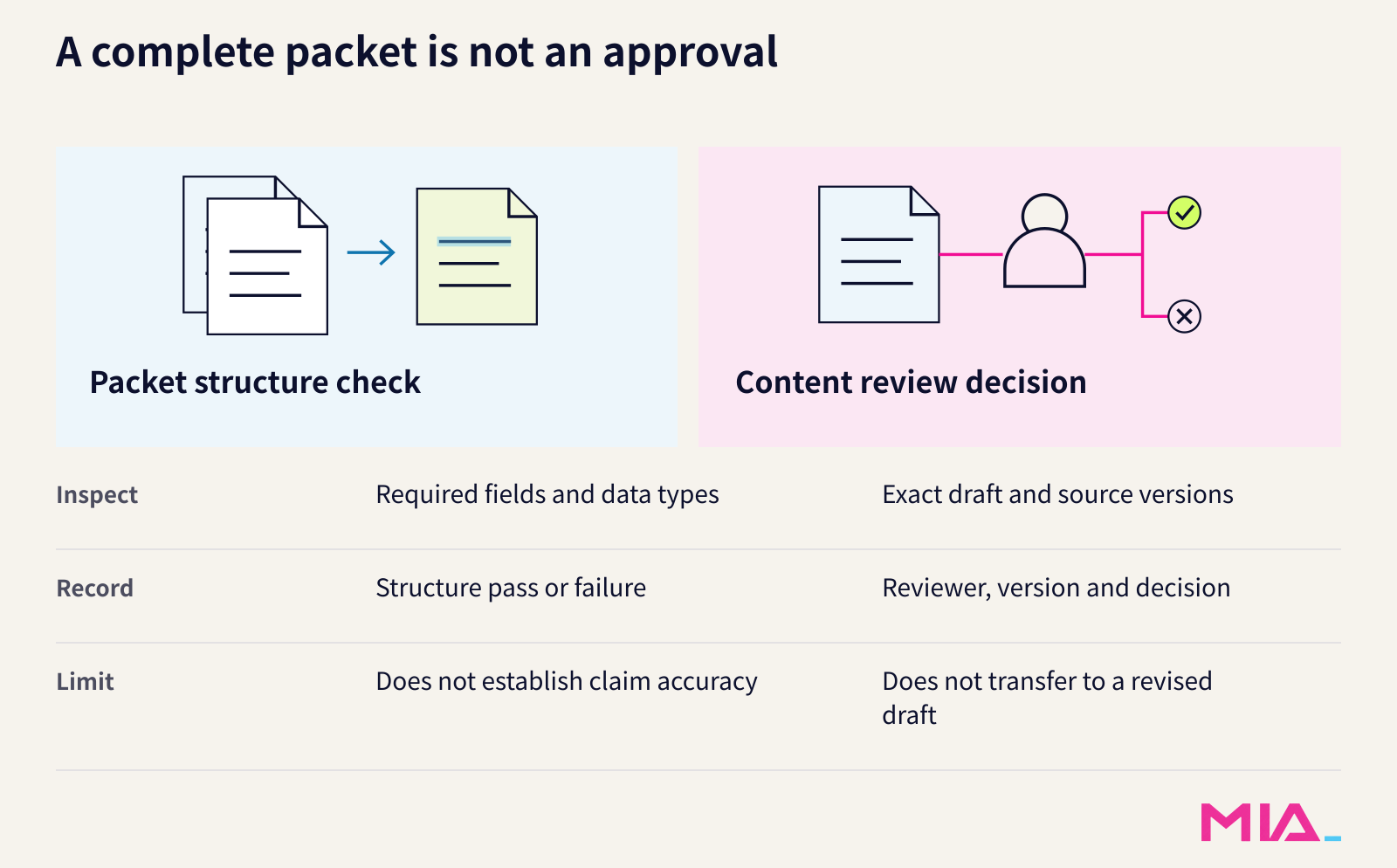
What belongs in a structured campaign draft handoff?
A marketing lead reviewing AI-written promotional copy needs more than the text: the brief, the exact draft, evidence for its claims and any unresolved questions. A structured review packet keeps those items together. It does not establish that the offer is correct.
Google’s structured-output documentation describes configuring Gemini model responses to follow a provided JSON Schema—a specification for the structure of a data response. The supplied page is labelled Gemini Generate Content API (Legacy). It provides background for this guide, not a verified current API recipe.
The documentation says syntactically correct JSON does not guarantee semantically correct values and tells applications to validate the final output. It also warns that schema-compliant output may not meet business requirements. A discount can occupy the right field and still be the wrong discount.
The proposed practice below therefore separates structure checks, factual verification, business-requirement checks and the authorized reviewer’s decision. It is not an existing MIA integration.
A campaign brief to content workflow: D3 against B7
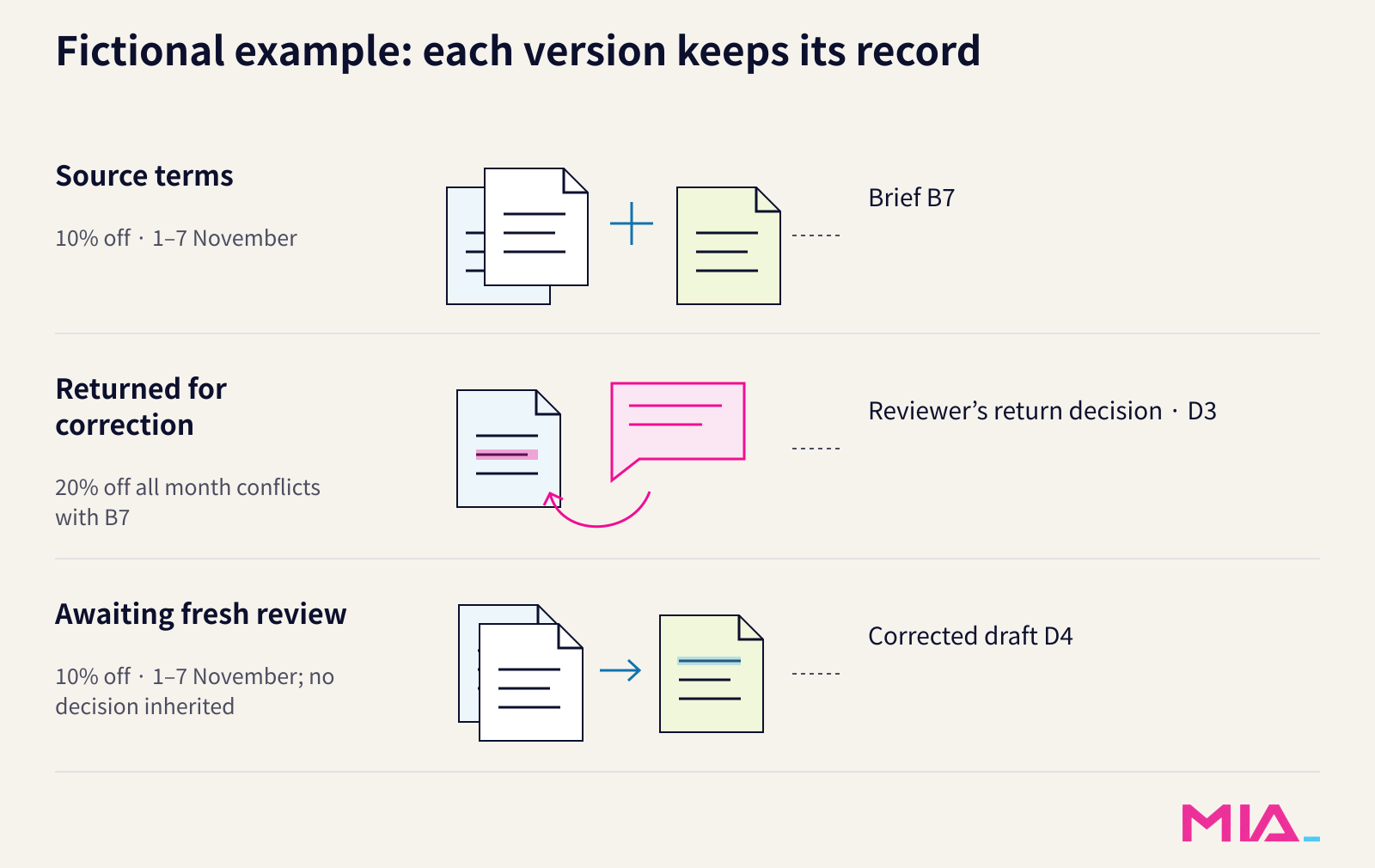
Consider a fictional two-person marketing team: a copywriter and a marketing lead authorized to review the campaign. Brief B7 approves 10% off from 1–7 November. AI-generated draft D3 instead says “20% off all month.” This is a teaching example, not an observed customer incident.
A minimal packet could contain these field/value pairs. This is a data example, not a Gemini schema or API request.
| Field | Illustrative value |
|---|---|
draft_version |
D3 |
brief_version |
B7 |
copy |
20% off all month. |
claim_register.claim_id |
C1 |
claim_register.quoted_claim |
20% off all month. |
claim_register.proposed_source_reference |
B7 — promotional offer terms |
business_requirements |
Discount and dates must match B7 |
unresolved_questions |
What supports 20%? What authorizes a month-long offer? |
The proposed source reference is a pointer, not proof. The reviewer must open the exact B7 and D3 files and read their terms and copy. In a real handoff, attach retrievable file locations and the relevant source passage; an ID alone is not evidence access.
Suppose an application checks the required fields and their expected types. In this fictional example, it records shape_check: pass for D3. A separate comparison records business_fact_check: mismatch: the discount and duration both conflict with B7. A structure pass must not overwrite that mismatch or become an approval.
Link each mismatch to a source and a responsible person
A short claim-to-source register makes the return actionable.
| Check | Claim and source | Mismatch | Next responsible action |
|---|---|---|---|
| Discount | D3 C1: 20%; B7: 10% | Unsupported increase | Copywriter corrects the discount against B7 |
| Dates | D3 C1: all month; B7: 1–7 November | Unsupported extension | Copywriter uses the approved dates |
| Evidence access | Exact D3 and B7 files | If either cannot be opened, verification remains unresolved | Marketing lead obtains the correct files before deciding |
Keep factual verification and business compliance separately identifiable even when the same comparison informs both. Reading B7 establishes the offer terms; checking the requirement establishes whether D3 follows the campaign instruction. Elsewhere, a factual statement might have a source but still fall outside the approved campaign scope.
The lead returns D3 for correction, naming the reviewer, the version and both mismatches. That return remains D3’s record.
D4 needs its own review decision
The copywriter prepares D4: “10% off from 1–7 November.” The reviewer opens D4 and B7, checks the corrected copy and records a new decision for D4. Do not copy D3’s decision onto D4. A corrected sentence is a reason to review again, not evidence of approval.
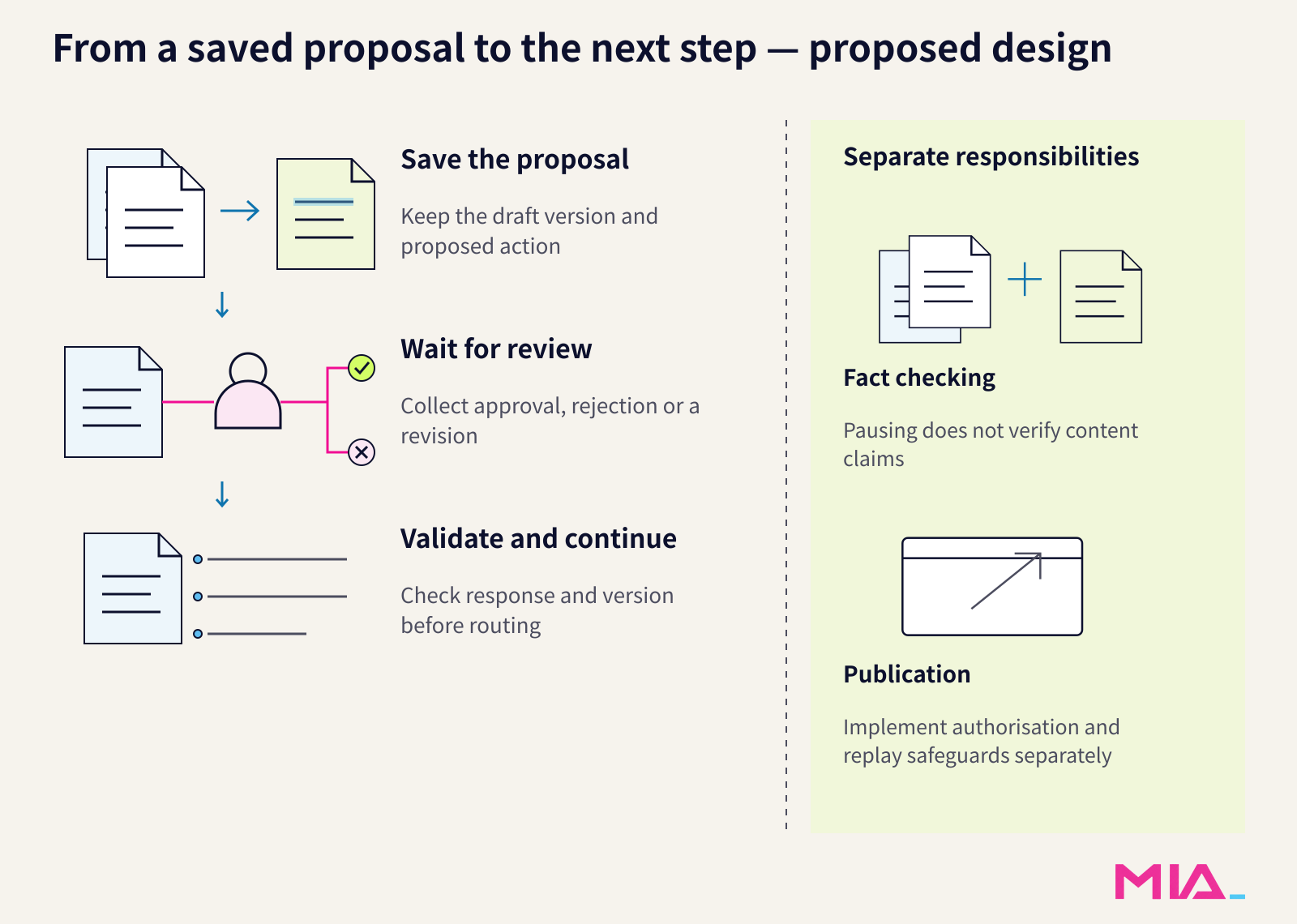
For teams deciding where that human checkpoint belongs, MIA’s Cowork workflow design describes inspectable inputs, outputs and handoffs, with a checkpoint that waits for a person to review, revise or approve. The page describes a design; specific access, retention and deployment controls require confirmation with the team. It does not establish a Gemini integration or implementation of this packet.
Start with one campaign claim. Attach the exact brief and draft, record what each check established, and assign any correction to a person. The handoff should make the evidence available for a decision—not turn filled fields into permission to publish.
More articles
Keep reading
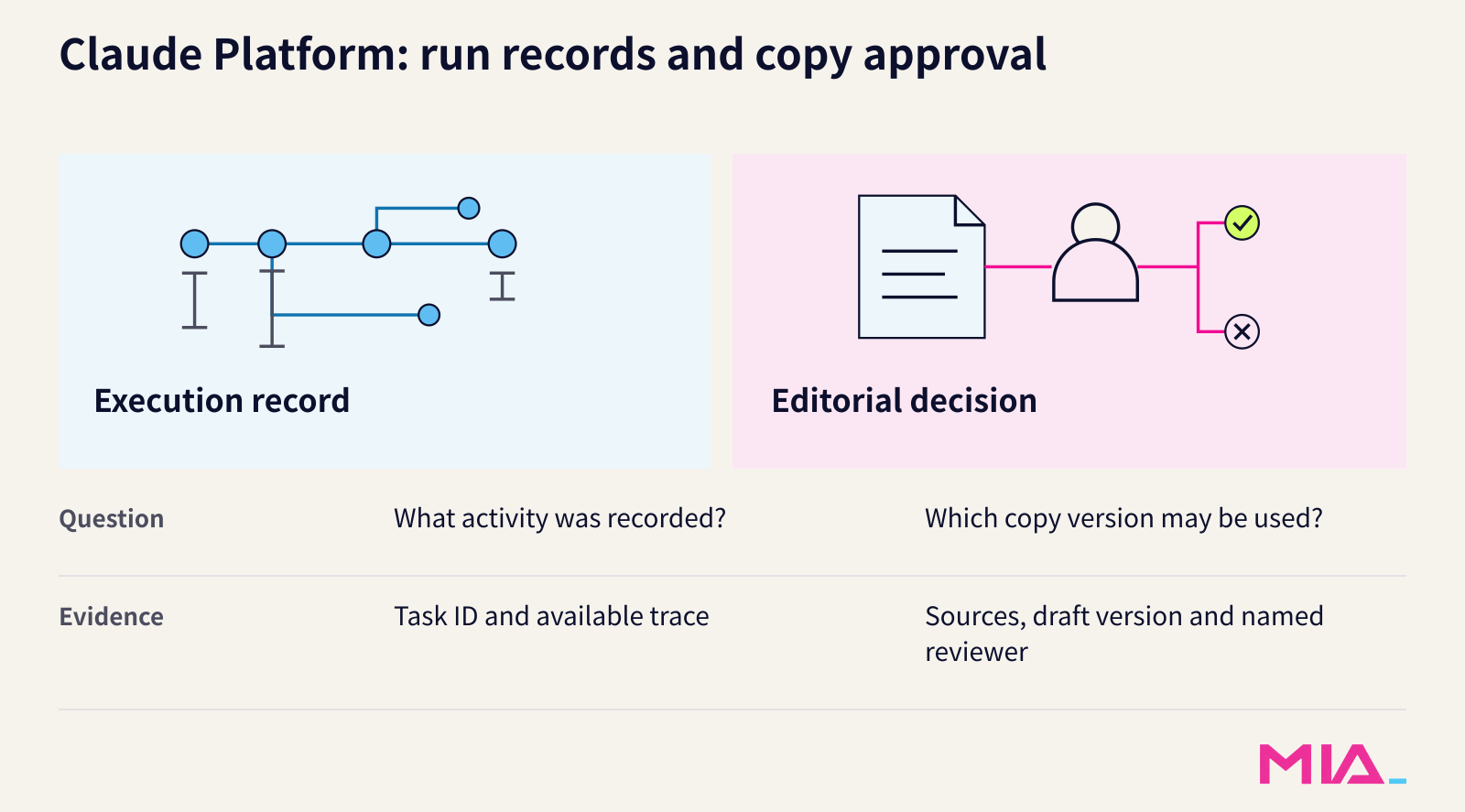
 Claude Platform traces are not content approvalWhat marketing teams should require alongside Claude Platform traces: source evidence, a reviewed draft version and controls for client materials.
 AI brief: OpenAI’s voice model successors and Vercel’s MCP Events betaOpenAI documents GPT-Live-1.1 and Quip, while Vercel adds event subscriptions for compatible MCP servers in public beta.
See how MIA carries the brief through Insight, Cowork and IQ.
The constraint set described here is what MIA IQ holds between tasks.