
AI marketing workflow
Claude Platform traces are not content approval
What marketing teams should require alongside Claude Platform traces: source evidence, a reviewed draft version and controls for client materials.
- Sources cited
- 1
- Sections
- 4
- Languages
- EN · 繁體 · 简体 · 日本語
Counted from the article file at build time, not asserted. Every claim below opens to one of these sources.
Can Claude Platform traces replace content approval?
Anthropic’s 14 October 2026 announcement covers OpenTelemetry traces from Claude Managed Agents, the Messages API and Claude SDKs on the Claude Platform.
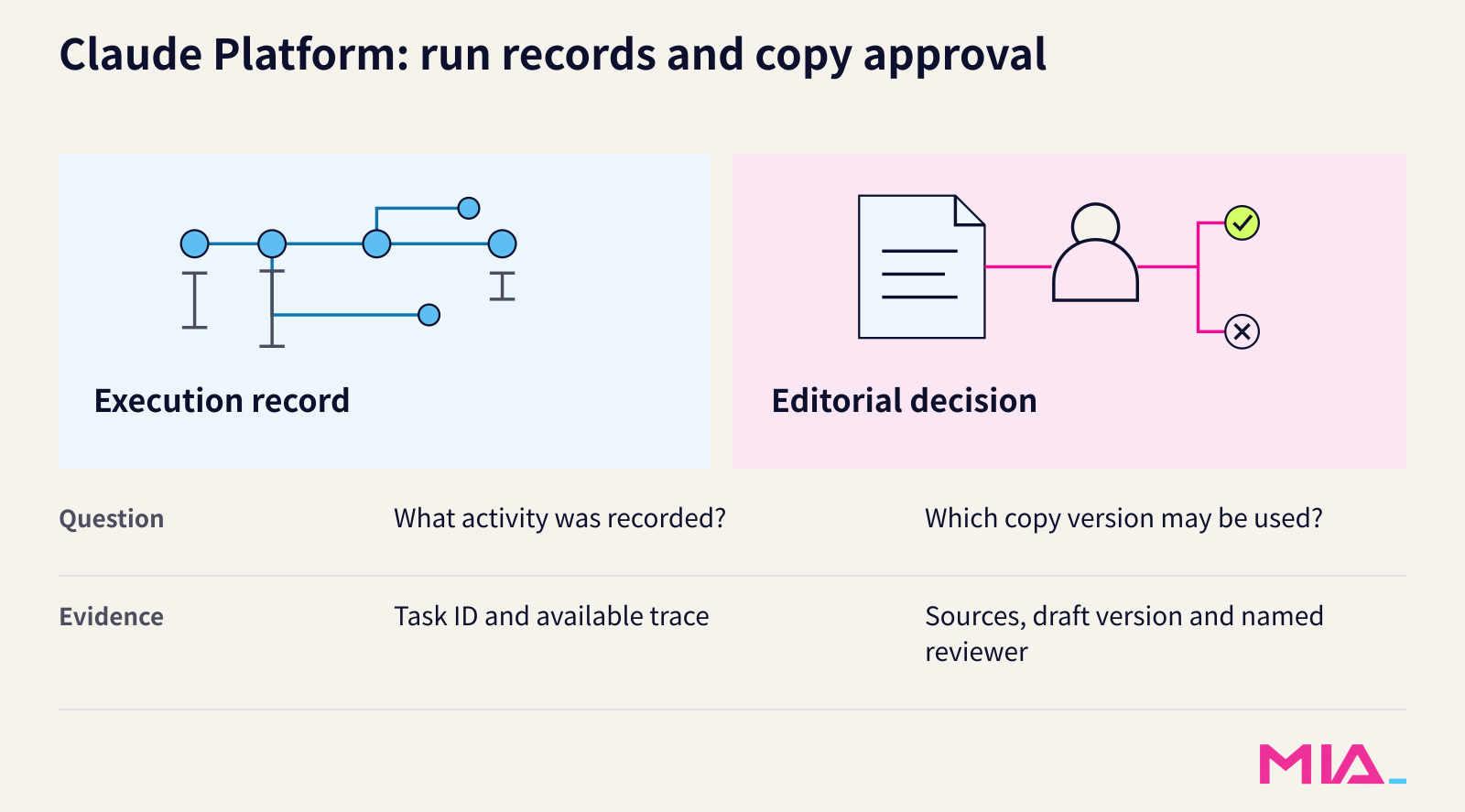
For a marketing lead deciding whether an AI agent should work with campaign materials, the important distinction is between recording execution and authorising content for release. A trace is an operational record: it can help investigate activity captured during a run. An editorial approval is a decision about a particular piece of content. One should not stand in for the other.
The announcement’s stated scope does not, by itself, establish which records your deployment captures, how client materials are protected or who has cleared a draft. Treat tracing as one part of the evidence you require, not as permission to widen access or publish.
An AI marketing workflow needs separate records
Consider a proposed pilot: an agent produces a social-post draft from an authorised product brief and approved source material. Keep publishing access outside the pilot.
The handoff should let a reviewer answer three different questions:
- What happened during execution? Keep the available run record, identify the task it belongs to and confirm what the record actually covers.
- What supports the copy? Attach a source-to-claim record so the reviewer can check each product statement against its evidence.
- Which version was cleared? Identify the draft version and keep a separate approval record naming the reviewer, the exact version and the decision.
These are recommended records, not a claim that Claude Platform automatically creates this editorial handoff. Linking them to the same task makes the distinction practical: a completed run may have produced a draft that is still awaiting review or has been returned for correction.
A traced draft can still need correction
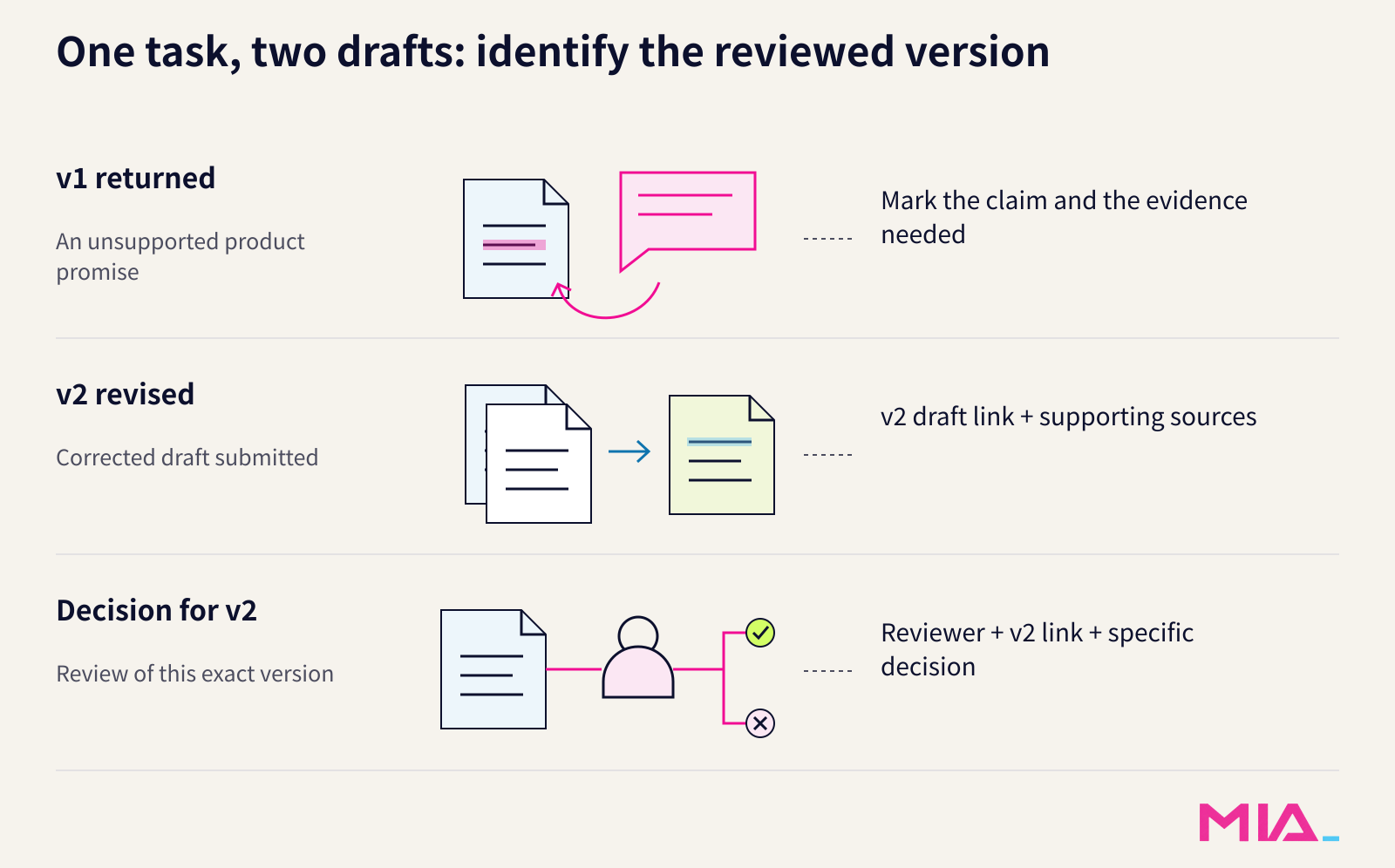
Suppose the pilot draft adds a product promise that the approved brief and sources do not support. Even if the execution was successfully traced, the copy should go back for correction. The trace does not supply the missing evidence for that promise.
After revision, the reviewer should inspect the changed version and record a new decision. An approval attached only to a task name is ambiguous when several drafts exist; the record should identify the actual content cleared.
This is also a useful lens for evaluating workflow design. MIA’s Cowork workflow design describes inspectable inputs, outputs and handoffs, with a checkpoint that waits for a person to review, revise or approve. The page explicitly leaves specific access, retention and deployment controls to confirmation with the team. That design addresses the handoff question; it is not evidence of a Claude OpenTelemetry integration or a tested client deployment.
Before client access, ask what leaves the workflow
A draft-only pilot limits the task, but it does not settle how materials and records are handled. Before introducing client content or expanding permissions, ask the implementation owner for deployment-specific evidence covering:
- Inputs and tools: which materials the agent may read, which tools it may use and how one client’s work is separated from another’s.
- Exported records: which fields leave the workflow, what sensitive content is removed, the destinations and who can access them. Confirm processing and storage locations separately.
- Retention and deletion: how long materials and records remain, and how deletion is handled at each destination.
- Credentials and revocation: how credentials are handled and how access is withdrawn when the pilot ends or a team member’s role changes.
These are acceptance questions, not verified Claude or MIA safeguards. If the answers are missing, do not introduce sensitive client materials or broaden the agent’s permissions.
Start with the authorised brief, a reviewable draft and no publishing access. Decide whether to expand the pilot only after you can connect execution records to source evidence, an exact draft version and a human decision—and account for where the materials go.
More articles
Keep reading

See how MIA carries the brief through Insight, Cowork and IQ.
The constraint set described here is what MIA IQ holds between tasks.